Sunday, December 14, 2014

final paper


Murica!
An analytical look into the portrayal of American in anime
By, Melvin L. Ellis
Part 1- The lenses of  anime


            So, as we all know, anime is a fantastical art medium, which can convey various meanings, stories, or genres. As we have seen in this course so far, the same goes for society and cultural views. We have spent the past semester exploring themes such as sexual identity ender norms, gender equality, and even philosophical things like being human. The reason we studied, discussed and analyzed those themes was due to the way we saw them presented. In those cases, they were shown through the lenses of anime. Therefore, they presented to us as reflected by cultural or individual views of the time. The same goes for nationality and ethnicity. When found to be a feature of an anime, what does it say? What does the American character reflect about the views of the Japanese public/animator; in relation to American foreigners? I found it to be an overshadowed topic, but a relevant one nevertheless. In this paper, I will draw from various anime over the years to extract what exactly the Japanese anime public conceives Americans to be.
Part 2- Brutes & Heroes!


            Brute: a harsh, very strong or forceful person; not having any reason; cruel and or savage person- Merriam-Webster dictionary
There are few anime which contain American characters fleshed-out enough for proper analyses. Scholarly papers on this subject are also scares, so I am limited to only a couple examples. I will begin by explaining that I will only discuss characters and anime which explicitly refer to a character as being American, or a setting that is also explicitly American.

The roles for Americans in anime are generally brutes or “heroes”. This is to say, they are typically depicted as an ignorant brute, or a hero in their own mind. The hero shows many stereotypical American-isms .these included, but was not limited to: constantly coming to someone else’s aid regardless of if they are needed, infringing on people with their own views, referring to themselves as a hero, and taking credit for a success or accomplishment. Characters also feel the need to mention their country of or origin. A well-known example of the ignorant “hero” in anime would be America, from the Hetalia series. 


He fits every one of the “hero” traits listed above. He has a tendency to overindulge in junk food, as well as hamburgers (stereotypical diet of unhealthy “fat” Americans).On top of that, Hetalia’s depiction of America is entirely based on a mix of American stereotypes and events from American history which bend the character to the forceful, idiotic character that they want American to be. For example, in episode 46 “Black Ships have Come “of the second series, America is order to “make friends” with Japan and get it to open its borders. This is done to reference the actions of commodore Perry in 1854. The narrator explains that “America sent a group of black war ships with a man named commodore Perry to politely ask them to trade or be wiped off the face of the earth”. I personally find most of this show extremely offensive.  Not only for the shameless stereotyping, but also for the offensive English dubbing. In this episode he asks “why do I have to go”. In the dub version he replies “YEAH! But only if I can kick ass and chew bubblegum! (A reference to the “Duke Nukem” franchise). America goes on to say “getting this cheap whale fat is too hard, can’t I just shoot them all?.” The character goes on to ignorantly bumble through conversations as he goes to Japan, not knowing any Japanese customs or language. For this paper, I decided to show this 5 minute episode to people I encountered in the park to get their opinions as Americans. I received almost 100% negative feedback, one person even telling me “this series is the equivalent to cultural black face (the equivalent to someone wearing black face for humor, in this case our country is being shamelessly made to look overly ridiculous)”.  As the series goes on, the characters America and Japan gradually become closer, but America’s overbearing and idiotic nature remains constant. 

 Another American character found in anime is Dan Eagleman (name obvious pun on the bald eagle). In the anime “Guilty Crown”, Dan is an American ex-athlete, now working with the special military group.  Similar to America (hetalia), he is upbeat, and sees himself as a hero. He is also known for giving pep talks to his subordinates and abusing his catchphrase “guts”. He is different from America, in that he has the personality of both the brute and the “hero”. Whether its defending women, fighting for “chivalry”, or exerting enough strength to knock over a surface-to-air missile, Dan Eagleman Is the Yankee for the job.

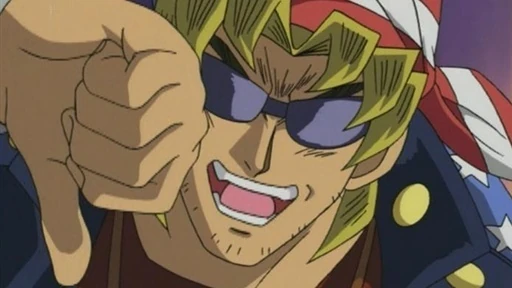
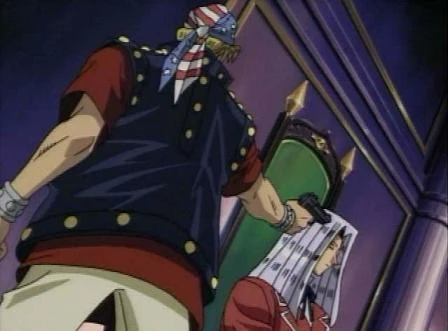
On the other end of the spectrum, opposite America (hetalia), we have “bandit” Keith Howard. With his baker vest, hulking appearance, and flag bandana, Keith is an obvious walking biker cliché. She enjoys stealing, bullying, and steak. He also hates sushi and is well known for his catchphrase, “in America”, ad even more known for being the only  civilian in the Yu-Gi-Oh series to hold someone at gunpoint. Keith is a brute in every sense of the world. He travels to Japan to defeat his adversary after losing to him in America, a failure he could never forgive. Unlike Dan and the Hetalia character, he shows none of the “hero” traits; not even remotely.


Earlier work and depictions

Early on in this semester, we took a look at early anime. Anime, as an art form was a product of post WW2 Japan. As such, many early anime featured war propaganda. Examples of this would be: ‘Evil Mickey attacks Japan” and “Momotaro’s Sea Eagle”.  In the first, the evil Mickey Mouse wages war on japan. Mickey; an American classic is depicted as a much more gruesome, feral animal. He attacks the happy island, and heroes from Japanese folklore must arrive to slay the evil mickey and defend their country. Among them we find Momotaro, who is featured in the second short film. In this film, we see him and his band of adorable animals launch a surprise attack on the demon island.  The large, boorish “demons” are drunken, sloppy and asleep for most of the attack. Leaving their aircrafts exposed to be destroyed by the sly and cute animals. Before the attack, we can see on the map, a place which resembles Pearl Harbor. So, we can conclude that the pathetic, sloppy “demons” were nothing else than Americans, as depicted for the war time anime. Meanwhile, the almost godlike Momotaro has a dignified appearance. He appears calm, in command, and has dominion and control over his animal subjects.  


Friday, October 24, 2014

Blog esay- Anime & Me


For as long as i can remember, anime has been a part of my life. From the days of racing home after elementary school to catch an episode of "Megaman" to taking a course at Ursinus College for the critically analyzing anime, it has always been an important part of my daily life. I could never imagine how my week would go if i didn't take at least 10 minutes out of the other 10080 to read a couple chapters of a manga or a new episode. Farther than just the overwhelming entertainment value that i receive from my favorite anime, i have always found it to be an amazing art form, one that it has been hard to find an equal to.

As I can recall, it started with Akira. I remember watching it with my dad when I was in elementary school. I was blown away by the share massive scale of the movie. I never knew that animated movies could be such large scale, nor did I know that “cartoons” could tell such deep stories. It was almost too much to handle. We watched it about three times in the week we saw it. Later on, when Toonami came into being, it only accelerated my fascination, as I tried to figure out what Anime was. Every Saturday, it was Yugioh in the morning, then toonami at night. Every weekday, I would get up at 5AM to catch an episode of “Detective Conan” or “Inuyasha” from the last night. It was almost like an addiction. Around the time I entered middle school, there wasn’t much new anime to watch besides “Naruto” and “One piece”.  So, with little-no social life, manga became the best cure for my boredom.  I actually attempted to make a manga, when I was in 7th grade. It was so much fun, and such a rewarding experience. However, my drawing skills were less than developed that time, so I ended up burring it; only to be recreated the day that my art can do the story justice .Things stayed similar to this, until I entered High school. I like to think, that was when I truly began to appreciate anime and manga.

            Be the time I reached 9th grade, anime and manga had dominated m life. I didn’t have many outside interest besides writing and drawing. I eventually found a unicorn in my north Philadelphia High school. Friends! Rea, actual people who had the same type of  interest as me! The five people I was able to befriend ended up being my best friends to this day. Looking back, it is still hard to believe that we were all drawn together by our individual loves for anime. Similar to “Otaku no Video”, we all had different loves for anime. Leander liked bishonen anime, and drawing attractive men. Darrah was in it for Magical Girl anime and wrote her own works. Shyheim (my brother) was pretty much the opposite of me, but my best friend none the less. Nevada is into J-RPG’s and Ivan studies animation and wants to create his own anime one day. The school was underfunded and the clubs were inadequate. Sports, sports, and more spots, was all they had to offer; with the exception of the film club we all joined. But eventually, our Otaku passion extended into the Japanese language. I spend two weeks writing a 12 page proposal for a “Japanese culture and Anime” school club. After my constant nagging (as president), we were approved. However, we received o funding. We spent the better part of a year learning basic hiragana (Japanese writing system), Trading cards, spending hours after school, debating our favorite anime, and sometimes not getting home until 7 or 8Pm. The environment was pure otaku overload. The club served as an oasis for all of us, in those days. At the start of summer, we had “otaku pool parties”. We would spend days swimming in my pool, making onigiri (failing at it), watching anime and other Japanese movies.

Anime united us with a strong bond that holds, even now. In the summer of 2013, I went with a couple friends to Otakon; an otaku convention in Maryland.  We all went in cosplay, stayed out late eating sushi, and it felt like those days in high school again. Then, there was the awkward moment when I return and mu parents wanted me to explain my cosplay: character, what anime, why I did it, how much I spent on it, all that. But my family has always been accepting of any cosplay or otaku activity I’ve done. Mainly because, everyone in my family likes anime in one way or another. My dad has an entire shelf of “Speed Racer” dvd’s and my mom always watched Naruto with me on those Saturday nights. For me, being the otaku that I am, things never slow down. I’m always scouring for new anime, or news of my favorite manga getting anime. When I’m not doing that, I’m keeping up with yugioh card trading news, which actually turned out to be a semi-lucrative business( as I have made enough selling cards to afford my books every semester).Anime has always played an important role in who I am today. In my younger days, I would always think to myself,   “I wanna be like Naruto. Even if I’m lonely, I want to succeed too”, or “I want to become a hero like Edward Elric.” Childish fantasies they may be, but they are strong beliefs that still hold meaning to me today. Being a “hero”, succeeding against all odds, believe in yourself, protecting your friends. It sounds odd when I say it out load but, these are all basic moral lessons that I had derived from my anime idols over the years, 

Monday, September 22, 2014

1st blossey- Code Geass

コード キアスー反逆のルルーシュ-Code Geass- Lelouch of the rebellion
Original Air Date               October 5, 2006
English Air Date April 20, 2008
Written by          Ichirō Ōkouchi
Directed by         Noriaki Akitaya
1-      The Origin – & first episode
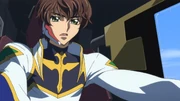
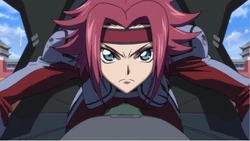
Code Geass- LOTB was first born from Okouchi’s small story concept. He desired to tell the story of a “hero” who would lead a rebellion and his friend. Generally, the two would equally want to change the world for the better, but having drastically different ideals, leading to an epic conflict, that would entangle the world in their fight. In interviews with Okouchi, he explains that he wanted to create “a hot series, that everyone could relate to”. Thus we have this; a dystopian future, where move 50% of the world is rules by the world’s dominant superpower; “The Holy Britanian Empire”; and The area formally known as “Japan” , now called “area 11” as well as the Japanese – “11s”. The Japanese are subservient to the Britanian and the World Is essentially riled by the royal family of Britania. The “Hero” that Okouchi delivered was “Lelouch Lampruge”, a britanian high school student, who was secretly “Lelouch Vi Britania”, the 11th heir to the Holy Britania Empire, and assumed dead since 10 years old. He lives with his disabled sister at a rich prep school. Lelouch  is dissected with the inequality of the world and, in one encounter with the Britanian military, and a mysterious girl named C.C (C-2), he is granted “Geass”- the power of kings. Lelouch’s role as the Hero & antihero Is assumed in the next moment, when he discovers that his specific geass is known as ultimate submission, as he orders the platoon of Britanian soldiers to “die”. An order to which, the happily oblige as they tur their guns on themselves. Lelouch goes on to use his strategic brilliance to command a group of Japanese `rebels, in combat to turn the tide of the battle, before assassinating his brother Prince Clovis; all of which was done in just a couple hours. Soon after, he reunites with his childhood friend, Suzaku Kurorugi; Japanese man who murdered the prior prime minister (his father) in order to stop Japan’s formal resistance against Britania.  Becoming an honorary Britanian through military service, Suzaku is a skilled combatant as well as Knightmare frame(mech) pilot. Despite being of Japanese origin and being known as a traitor to the Japanese people, Kurorugi desires to change the circumstances through political means. Through a series of lucky breaks, he is elevated to the status of knighthood, guardian to a princess, and gains significant power. All the while, Lelouch uses his intellect to create an alter ego: Zero. As Zero, he transforms the terrorist group into “the black knights”, an army to fight for justice and the restoration of Japan. Among the soldiers is Kallen Kozuki, a half britanian who attends school under the last name Stadtfeld, in order not to be subjected to racism and keep her terrorist involvement under wraps. She is introduces as the antithesis if Kurorugi; she is as skilled and strong of a pilot and fighter, but believes that Japan can only be free once Britania is no more  .The friends keep their identities secret at the Britanian prep school, as they stride for the same goal, with different means.  Although it is a mech anime, the target audience is not specifically a gender or age group.


2.1- Themes & tone-The themes that are featured in this anime are heavy, contemplative, and inspiring.  It is very much an “us against the world”, as well as serious issues of equality. It asks the question “what is Japan” and “what Japanese is”.   It is a world of people, struggling to regain their name and cultural identity as a whole. Appear from Japanese, the anime features the remnants of China, who Lelouch rallies into his fight.
As a whole, the series is a struggle good vs. evil, but on a much more complicated level. This struggle is seen when Zero poses the question to a britanian military officer-  "Let me ask you something, Lord Guilford. Suppose there is an evil that justice cannot bring down. What would you do? Would you taint your hands with evil to destroy evil? Or would you carry out your own justice and succumb to that evil?” It is these types of scenarios that break the polarization of good and evil, and disregard the means.

2.2- Real Robot- This may be called a mech anime, although the mechs are far from the main facet in the Code geass universe. The Knightmare frames, are war machines, used in the conflicts, and are generic, for the most part. All with the exception of a few: the Lancelot and then Guren,.  These take on significance in the series, due to their symbolism and relevance beyond being a machine. The Lancelot; named after the knight of the round table, was given to Kurorugi during the second episode by the Britain military to halt Lelouch’s initial assault after obtaining geass. It is an experimental Knightmare frame, and extremely powerful and mobile compared to generic models. Suzaku- Japanese wields this power symbol of Britanian military might against countless members of the black knights and Japanese liberation front. Kurorugi, already being dubbed a traitor to his own people is hated even more by the Japanese for using such a device. All the while, he endures it and holds strong to hi ideals of peace through political means.
Lancelot

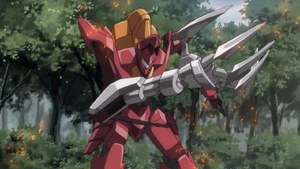
The guren was a prototype Knightmare frame, engendered by Indian scientist, and given to Kallen. It is faster and stronger than the Lancelot, and stands as Japan’s response to Kurorugi and his machine. The fighting style is more furious, and it sports a Japanese flag on the screen once it is started. With this, Kallen basically caries the fight and the guren becomes known as Japan’s secret weapon against Britania.
guren

3-Geass- Geass is known as “the power of the king”. It served as an ocular power by which Zero amasses his vast power and army. It is later found that Lelouch’s geass manifested based on his innermost desire, as they always do. He finds that out as the anime explains that his life was in ruins all this time, despite being a privileged prep student. His sister crippled, mother murdered, assumed dead, in a hateful world. All of this chaos drove him to desire one thing; control. That came in the form of his ultimate submission geass.

3-

As the story develop on, Lelouch’s goals shift from creation of a free world by means of his black knight army, to world supremacy , as seen in the later series “Code Geass R2”.I deeply believe that this anime should be shown in the class, as well as CIE class. It forces a people to question “what are we fighting so hard for?” and what is a cultural identity that is worth preserving so much. Stylistically speaking, Lelouch’s black knight perfectly complements Suzaku’s white knight ideals. I found that Ōkouchi succeeded in creating  “a character that everyone could relate to”.


Sources:codegeass.wikia.com - images
Code Geass & Code Geass R2 complete series DVD set (best $60 i ever spent)