‘Murica!
An analytical look into the portrayal of American in anime
By, Melvin L. Ellis
Part 1- The lenses of anime
So, as we all know, anime is a fantastical art medium, which can convey various meanings, stories, or genres. As we have seen in this course so far, the same goes for society and cultural views. We have spent the past semester exploring themes such as sexual identity ender norms, gender equality, and even philosophical things like being human. The reason we studied, discussed and analyzed those themes was due to the way we saw them presented. In those cases, they were shown through the lenses of anime. Therefore, they presented to us as reflected by cultural or individual views of the time. The same goes for nationality and ethnicity. When found to be a feature of an anime, what does it say? What does the American character reflect about the views of the Japanese public/animator; in relation to American foreigners? I found it to be an overshadowed topic, but a relevant one nevertheless. In this paper, I will draw from various anime over the years to extract what exactly the Japanese anime public conceives Americans to be.
Part 2- Brutes & Heroes!
Brute: a harsh, very strong or forceful person; not having any reason; cruel and or savage person- Merriam-Webster dictionary
There are few anime which contain American characters fleshed-out enough for proper analyses. Scholarly papers on this subject are also scares, so I am limited to only a couple examples. I will begin by explaining that I will only discuss characters and anime which explicitly refer to a character as being American, or a setting that is also explicitly American.
The roles for Americans in anime are generally brutes or “heroes”. This is to say, they are typically depicted as an ignorant brute, or a hero in their own mind. The hero shows many stereotypical American-isms .these included, but was not limited to: constantly coming to someone else’s aid regardless of if they are needed, infringing on people with their own views, referring to themselves as a hero, and taking credit for a success or accomplishment. Characters also feel the need to mention their country of or origin. A well-known example of the ignorant “hero” in anime would be America, from the Hetalia series.


He fits every one of the “hero” traits listed above. He has a tendency to overindulge in junk food, as well as hamburgers (stereotypical diet of unhealthy “fat” Americans).On top of that, Hetalia’s depiction of America is entirely based on a mix of American stereotypes and events from American history which bend the character to the forceful, idiotic character that they want American to be. For example, in episode 46 “Black Ships have Come “of the second series, America is order to “make friends” with Japan and get it to open its borders. This is done to reference the actions of commodore Perry in 1854. The narrator explains that “America sent a group of black war ships with a man named commodore Perry to politely ask them to trade or be wiped off the face of the earth”. I personally find most of this show extremely offensive. Not only for the shameless stereotyping, but also for the offensive English dubbing. In this episode he asks “why do I have to go”. In the dub version he replies “YEAH! But only if I can kick ass and chew bubblegum! (A reference to the “Duke Nukem” franchise). America goes on to say “getting this cheap whale fat is too hard, can’t I just shoot them all?.” The character goes on to ignorantly bumble through conversations as he goes to Japan, not knowing any Japanese customs or language. For this paper, I decided to show this 5 minute episode to people I encountered in the park to get their opinions as Americans. I received almost 100% negative feedback, one person even telling me “this series is the equivalent to cultural black face (the equivalent to someone wearing black face for humor, in this case our country is being shamelessly made to look overly ridiculous)”. As the series goes on, the characters America and Japan gradually become closer, but America’s overbearing and idiotic nature remains constant.

 xc
xc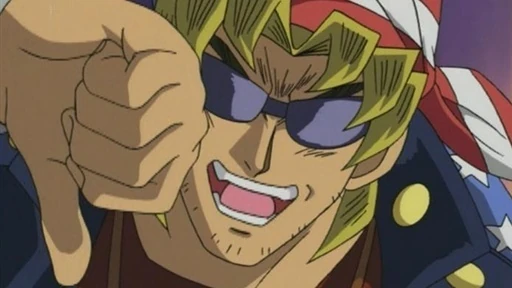
 On the other end of the
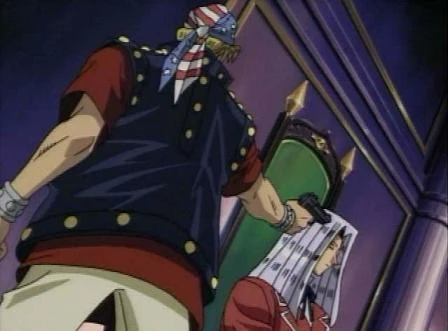
spectrum, opposite America (hetalia), we have “bandit” Keith Howard. With his
baker vest, hulking appearance, and flag bandana, Keith is an obvious walking
biker cliché. She enjoys stealing, bullying, and steak. He also hates sushi and
is well known for his catchphrase, “in America”, ad even more known for being
the only civilian in the Yu-Gi-Oh series
to hold someone at gunpoint. Keith is a brute in every sense of the world. He
travels to Japan to defeat his adversary after losing to him in America, a failure
he could never forgive. Unlike Dan and the Hetalia character, he shows none of
the “hero” traits; not even remotely.
On the other end of the
spectrum, opposite America (hetalia), we have “bandit” Keith Howard. With his
baker vest, hulking appearance, and flag bandana, Keith is an obvious walking
biker cliché. She enjoys stealing, bullying, and steak. He also hates sushi and
is well known for his catchphrase, “in America”, ad even more known for being
the only civilian in the Yu-Gi-Oh series
to hold someone at gunpoint. Keith is a brute in every sense of the world. He
travels to Japan to defeat his adversary after losing to him in America, a failure
he could never forgive. Unlike Dan and the Hetalia character, he shows none of
the “hero” traits; not even remotely.

Earlier
work and depictions
 Early on in this
semester, we took a look at early anime. Anime, as an art form was a product of
post WW2 Japan. As such, many early anime featured war propaganda. Examples of
this would be: ‘Evil Mickey attacks Japan” and “Momotaro’s Sea Eagle”. In the first, the evil Mickey Mouse wages war
on japan. Mickey; an American classic is depicted as a much more gruesome, feral
animal. He attacks the happy island, and heroes from Japanese folklore must
arrive to slay the evil mickey and defend their country. Among them we find Momotaro,
who is featured in the second short film. In this film, we see him and his band
of adorable animals launch a surprise attack on the demon island. The large, boorish “demons” are drunken,
sloppy and asleep for most of the attack. Leaving their aircrafts exposed to be
destroyed by the sly and cute animals. Before the attack, we can see on the
map, a place which resembles Pearl Harbor. So, we can conclude that the pathetic,
sloppy “demons” were nothing else than Americans, as depicted for the war time
anime. Meanwhile, the almost godlike Momotaro has a dignified appearance. He
appears calm, in command, and has dominion and control over his animal
subjects.
Early on in this
semester, we took a look at early anime. Anime, as an art form was a product of
post WW2 Japan. As such, many early anime featured war propaganda. Examples of
this would be: ‘Evil Mickey attacks Japan” and “Momotaro’s Sea Eagle”. In the first, the evil Mickey Mouse wages war
on japan. Mickey; an American classic is depicted as a much more gruesome, feral
animal. He attacks the happy island, and heroes from Japanese folklore must
arrive to slay the evil mickey and defend their country. Among them we find Momotaro,
who is featured in the second short film. In this film, we see him and his band
of adorable animals launch a surprise attack on the demon island. The large, boorish “demons” are drunken,
sloppy and asleep for most of the attack. Leaving their aircrafts exposed to be
destroyed by the sly and cute animals. Before the attack, we can see on the
map, a place which resembles Pearl Harbor. So, we can conclude that the pathetic,
sloppy “demons” were nothing else than Americans, as depicted for the war time
anime. Meanwhile, the almost godlike Momotaro has a dignified appearance. He
appears calm, in command, and has dominion and control over his animal
subjects.